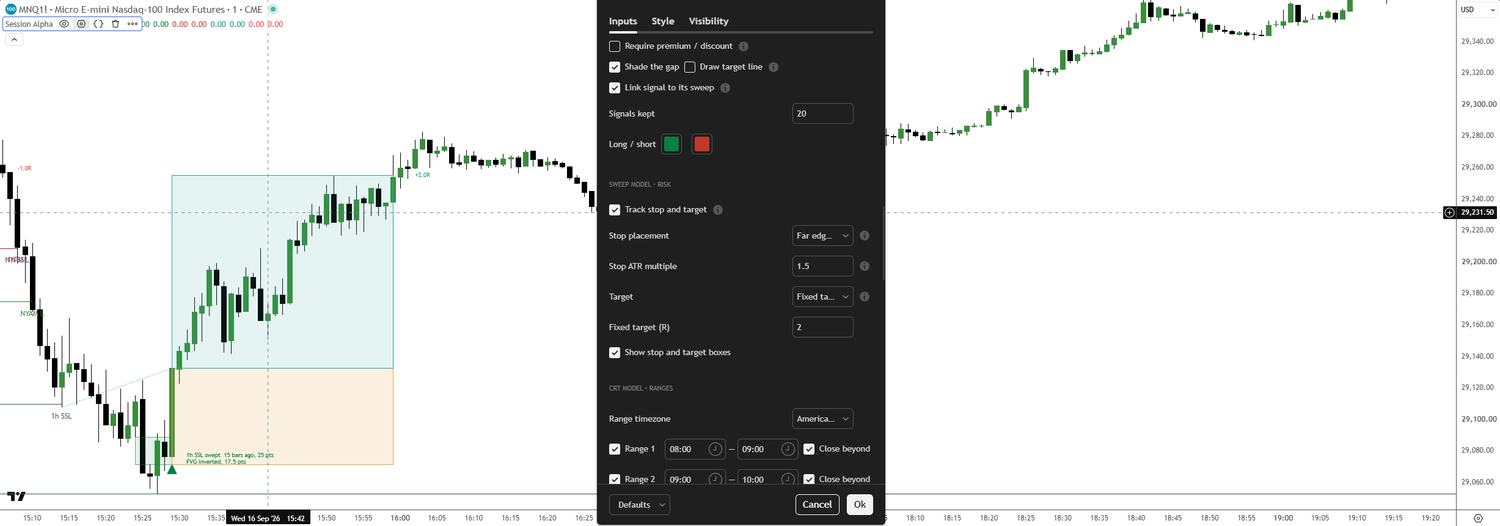
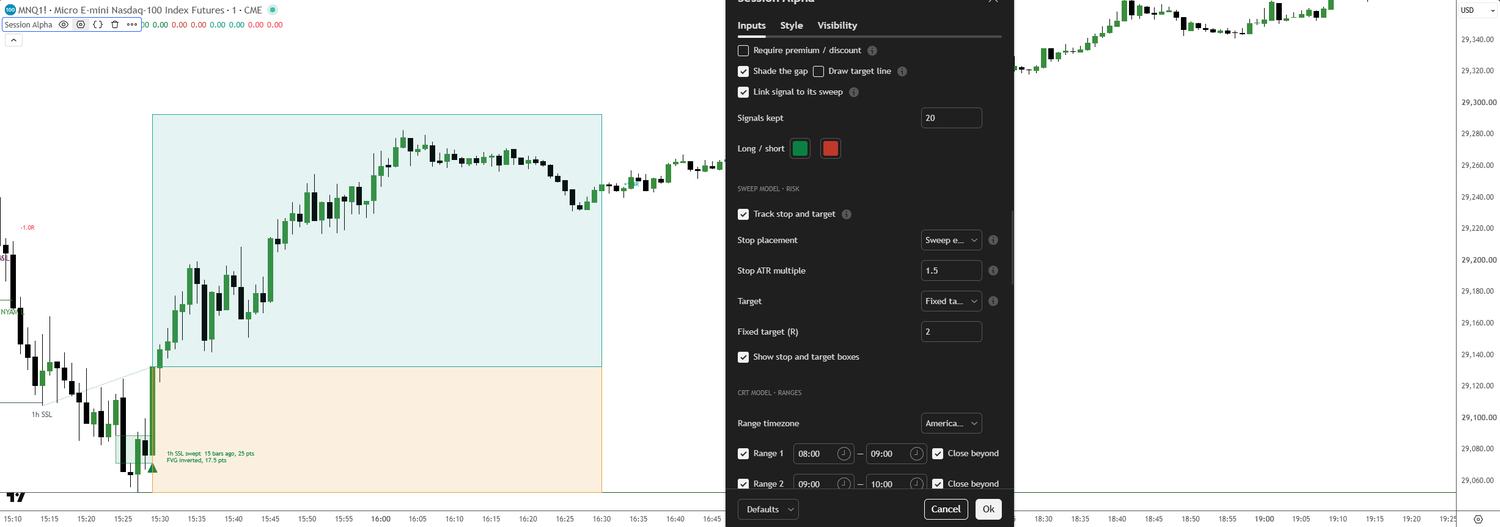
Around 1,600 lines of Pine, run session by session over many days. Every filter in it exists because something went wrong without it.
Asia, pre-London, the New York morning, plus a spare slot. Each records its own high and low and watches for a sweep of either edge. Turn off the ones you do not trade.
Drawn and kept live until something takes them out. Any of them can arm a setup.
Swing highs and lows read from the hourly chart regardless of the timeframe you are on, so the levels do not change when you zoom.
Highs, lows and opens, with lines that stop drawing once the level has been cleared.
Reference levels, and the basis of the optional premium / discount filter.
In points, or as a multiple of ATR so it scales with volatility. Gaps under the threshold still draw as dimmed markers with the shortfall printed, so you see what was excluded.
A gap that forms long after the sweep belongs to a different move. Without this bound a setup can be claimed by an unrelated gap far away, leaving an entry stranded from its own stop.
How far beyond the range price may travel and still count as a sweep rather than a breakout.
Rejects a setup where the stop is too far relative to the room left inside the range.
Optional. Requires a prior 5-minute extreme to have been taken and closed back through.
Optional. Requires a gap from the sweep leg that price has closed back through.
Whether a failed setup gets a second try, and on the Sweep model the next only arms once the previous trade has closed.
Restrict when entries may fire without restricting when the sweep may happen, and skip the minutes around the New York open where a one-minute candle can mean nothing.
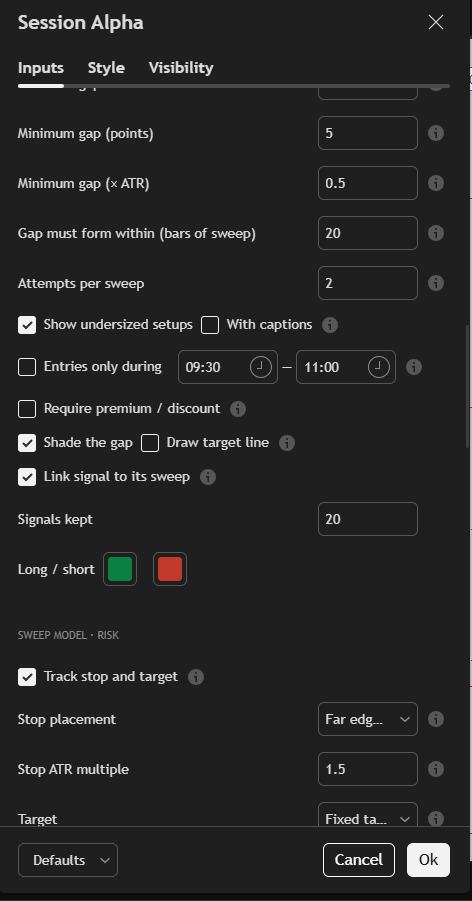
Three stop modes and two target modes. None of them changes how many signals you get — they change what happens on the signals you were already getting.
Sizes from volatility instead. Use knowingly — it ignores the setup, so on a deep sweep it can land inside the sweep leg.
Predictable and easy to size against.
Aims at the closest untouched level on the profit side. Often pays more than a fixed target, but you cannot know your R before you take the trade.
What was swept, how many bars ago, how far price has travelled since, and the size of the gap that inverted. CRT signals also name the range and list which confirmations fired.
Drawn at entry, closed at the exit, with the R outcome printed beside them.
Plain text or JSON for a webhook, carrying entry, stop, target and R, plus an optional account tag so a receiver can route the order.
Separate from the model alerts. Fires when a level is traded through — a heads-up that a setup may be forming.
Every model decision is made on a closed bar. A wick that pokes through a level and recovers cannot consume a setup or fire an alert.
The CRT model runs on 1-minute charts only. Anywhere else it switches off and says so at the bottom of the chart, rather than silently doing nothing.